Pāhoehoe (pah-HOY-hoy)
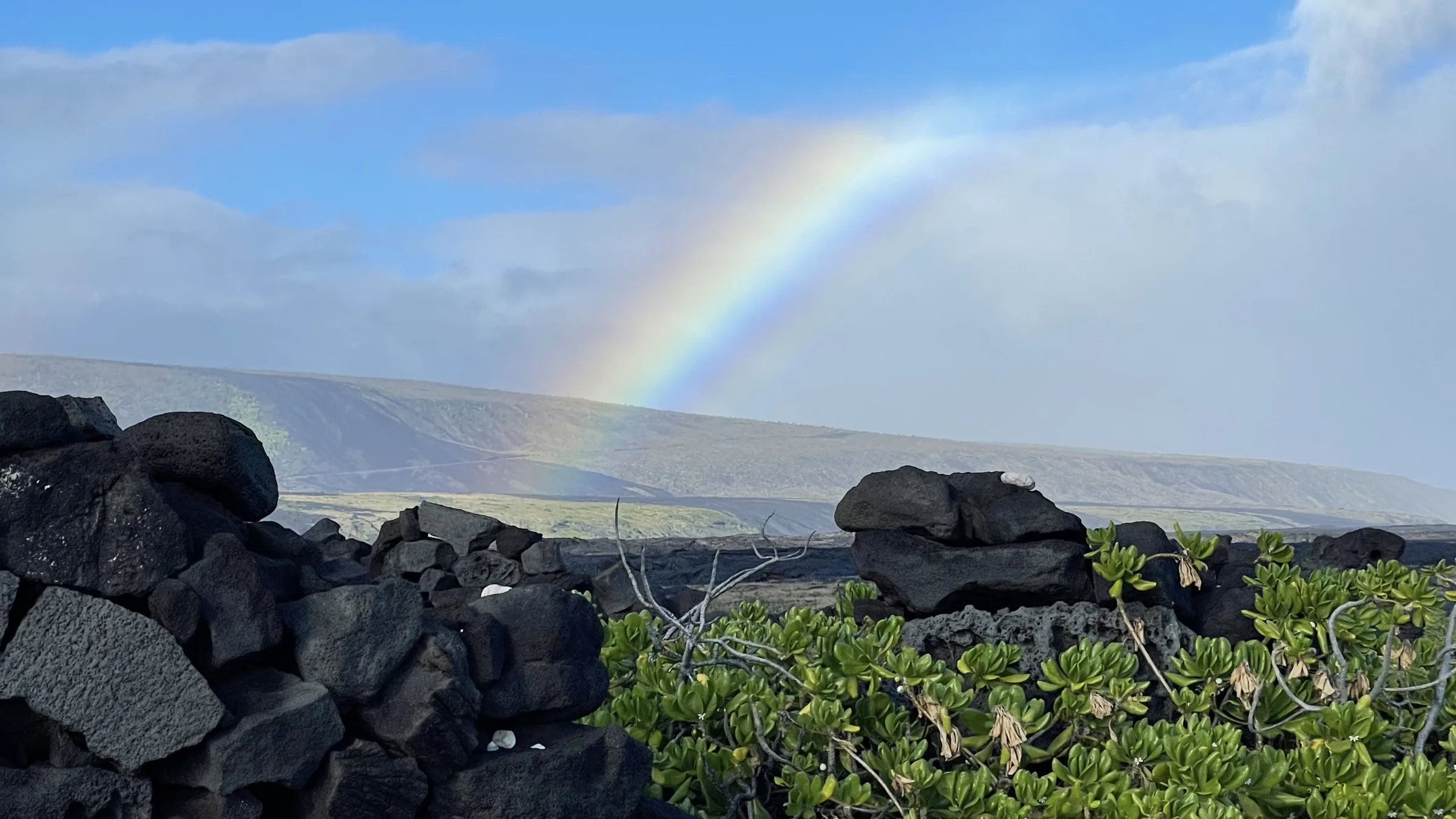
Smooth, ropy lava that flows like hot honey and wrinkles into folds, coils and little rounded “toes” as its skin cools. It's hot, runny and full of gas, so it can travel for miles inside tubes it builds for itself. Old pāhoehoe is the black, glossy rock that much of Kaʻū is built on — including the lot this studio stands on.
Where it shows up in the work: the folds and ropes carved into the lava reliefs.
ʻAʻā (ah-AH)
Pāhoehoe's rough twin. Cooler, thicker lava tears itself into sharp, jagged chunks called clinker that tumble forward like a rolling pile of broken glass. Locals like to joke the name is the sound you make crossing it barefoot.
Where it shows up: the rough, broken textures and dark edges in the Kaʻū reliefs.
Lava fountain (and “episode”)
When gas-rich magma races up a vent, it can spray lava hundreds of feet into the air. Kīlauea's summit eruption, which began on December 23, 2024, has come in episodes: bursts of fountaining in Halemaʻumaʻu, then a pause while the volcano refills.
Where it shows up: one relief for each episode in the 2026 Kīlauea series.
Pele's hair
Strands of golden volcanic glass, thin as hair, spun by the wind from fountaining lava. After big fountains it drifts for miles and catches on fences and grass.
Pele's tears
Tiny black beads of volcanic glass, often with a tail of Pele's hair, formed when droplets of lava cool in midair.
Tephra (TEF-ruh)
A catch-all word for anything a volcano throws into the air: ash, cinders, Pele's hair and Pele's tears.
Lava tube
A river of pāhoehoe that roofs itself over. The surface cools and hardens while hot lava keeps flowing underneath, and when it drains it leaves a cave. Nāhuku (Thurston Lava Tube) in Hawaiʻi Volcanoes National Park is one you can walk through.
Kīpuka (kee-POO-kah)
An island of older land and forest left standing when a lava flow splits around it. A kīpuka is a seed bank: life on it re-greens the new rock around it.
Where it shows up: the idea that beauty is always here to step inside, even within destruction.
Caldera & Halemaʻumaʻu (hah-leh-MAH-oo-MAH-oo)
A caldera is the huge collapsed bowl at a volcano's summit. Halemaʻumaʻu is the crater inside Kīlauea's caldera, where the current eruption fountains — and, in Hawaiian tradition, the home of Pele.
Shield volcano
A volcano built from thousands of runny lava flows stacked into a broad, gentle dome, like a warrior's shield laid on the ground. Mauna Loa, the mountain behind the studio, is the largest active volcano on Earth.
Where it shows up: Mauna Loa's long, low profile in the Kaʻū reliefs.
Vog
Volcanic smog: haze made when volcanic gas reacts with sunlight and moisture. Trade winds often carry it around the island toward Kaʻū.
Kiʻi pōhaku (KEE-ee POH-hah-koo)
Petroglyphs: figures, circles and dots pecked into lava by Hawaiians long ago. At Puʻuloa in Hawaiʻi Volcanoes National Park, thousands of them cover the pāhoehoe, and many small cupped holes once held a newborn's piko for a long life. They're sacred: look from the boardwalk, and never touch or trace them.
Why it matters to the work: a mark on new rock that says this place matters. Read the journal entry →
ʻŌhiʻa lehua (oh-HEE-ah leh-HOO-ah)
The native tree that's often among the first to grow on new lava, with bright red pom-pom blossoms. It's a symbol of life coming back after the fire.
Where it shows up: the ʻōhiʻa lehua reliefs.